1 / Looking back on Celebrity Traitors, what were some of the biggest creative challenges you personally faced when shaping the sound?
“Looking back on Celebrity Traitors, one of the biggest creative challenges for us was actually quite different from what most people might expect. A lot of the overt “creative” work the sound design and editorial choices, has already been done before it reaches us. So our role is less about adding and more about refining, shaping, and, in many ways, removing.
A huge part of the challenge is cleaning and controlling the sound. Because it’s a reality format, you re dealing with unpredictable environments, wind, background noise, multiple celebrities speaking at once. Cross talk is a big one. You’ll often have someone delivering an important line, but there are fragments of other voices bleeding through underneath. And that’s where it becomes quite technical but also quite creative. You’re often combining different tools and techniques to solve problems that, on the surface, seem impossible. That problem-solving aspect is where the creativity really lies for us.
Filming conditions in Scotland add another layer of complexity. Wind, in particular, is a constant challenge. You might have one celebrity with a clean signal and another whose mic is being completely overwhelmed. Balancing those differences so that everyone sounds consistent is incredibly tricky. I think that’s the key thing our creativity is often hidden. If we’ve done our job well, no one notices. The sound just feels right.
There’s also the challenge of maintaining continuity. Sound doesn’t stop, your ears are always taking everything in. So if there are gaps, inconsistencies, or sudden changes, the audience picks up on it immediately. It’s also very much a team effort. Track layers, editors, mixers, everyone plays a part in shaping the final result.
So overall, the biggest creative challenge isn’t necessarily about adding dramatic elements, it’s about precision, problem-solving, and making complex audio feel completely natural”
2 / Winning a BAFTA is an incredible achievement, what does it mean to you personally?
“Winning a BAFTA honestly means a huge amount to me especially because it didn’t come quickly. I’d been nominated once before for a BAFTA, and l’d always been just on the edge of winning one, never quite getting there. So in a way, that journey made this one feel even more meaningful.
What made it even more surreal was how unexpected it all was. I didn’t even realise l’d been nominated at first, it was mentioned to me quite casually, and then suddenly l’m being told I might be going to the BAFTAs. There wasn’t that usual build-up, it just escalated very quickly, so by the time we were there, it still didn’t quite feel real.
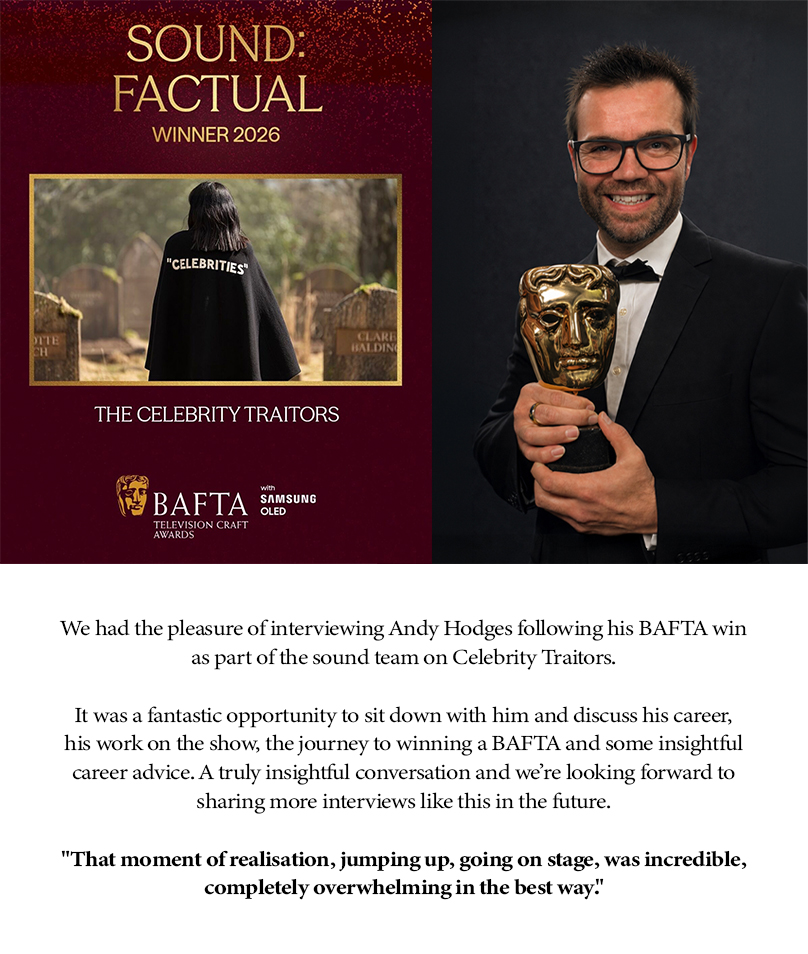
Then when they announced it… we almost missed it. They said “Celebrity” first and we assumed it was someone else, and then suddenly it was us. That moment of realisation, jumping up, going on stage, was incredible, completely overwhelming in the best way.
For me personally, though, the most important part isn’t just the win it’s the recognition. The first time I was nominated for a BAFTA, it gave me a real sense of confidence and validation, knowing that my work had been recognised at that level.
So to finally win one now, and actually hold it in my hands, is amazing. I’m genuinely over the moon. It still feels surreal, especially as it was a team award, and I’m incredibly proud of that. It’s something no one can take away. From being nominated to now winning, it’s a real milestone, and something I’m really proud of.”
3 / Thinking about your own career journey, what advice would you give to anyone hoping to get into sound for television?
“Thinking about my own career journey, the biggest piece of advice l’d give is to be really clear about what you want, and then go after it properly.
People can progress very quickly in this industry if they’re focused. If you know where you want to get to, you can move through the early stages much faster than you might think. Be proactive, learn as much as you can, apply it, and show people what you can do. If you can demonstrate that you’ve got the skills and that you’re reliable, that opens doors very quickly.
Another really important part is your attitude. This industry is built on relationships, so being someone people want to work with makes a huge difference. Be approachable, adaptable, and take a genuine interest in others. Don’t be afraid of the things that feel daunting, you should actively seek them out. The moments where you feel out of your depth are the ones where you learn the most. If something scares you a bit, it’s usually a sign you’re moving in the right direction.
And finally, take every opportunity you can, especially early on. Don’t wait for the “perfect” project. Some of the smaller jobs can lead to much bigger opportunities. Its about putting the time in, staying curious, and being willing to push yourself.”
“Job satisfaction. I think one of the most important things, for me personally, is that you have to enjoy what you do. That was always a major factor in choosing my career. I never wanted to end up in a job where I dreaded getting up in the morning.
If you’re going to work every day and you hate it, that’s not sustainable. It wears you down. And I know it’s not always easy to change direction, but I do think it’s important to at least aim for something that gives you a sense of satisfaction.
For me, I genuinely enjoy my days. I come into work, I’m engaged, I’m creating something, I’m solving problems and then I go home still feeling positive about the day. That’s a great place to be.
If you can get to that point where you enjoy what you do, it stops feeling like work altogether. It just becomes part of your life in a really positive way. And I think that’s what people should aim for finding something that gives them that level of job satisfaction.”